The global financial infrastructure has served the economy remarkably well for decades, handling trillions of dollars in daily volume with resilience and trust. However, as markets demand greater velocity and precision, the reliance on batch processing and manual reconciliation can create operational friction.
Fund tokenization does not seek to replace this established foundation. Instead, it represents an additive upgrade - a "format shift" that brings the reliability of traditional finance onto a shared, programmable ledger. This offers the potential to enhance speed and data synchronization without discarding the safeguards that make the system work.
This guide provides a practical roadmap for financial institutions looking to navigate fund tokenization in 2026. We look at the structure, the risks, and how this technology is beginning to streamline capital formation.
What is Fund Tokenization?
At its core, tokenization is the creation of a digital representation of an asset on a distributed ledger. When we talk about fund tokenization, we are typically referring to the issuance of digital tokens that represent shares or units in a traditional investment fund.
Think of it as a format change. Just as music moved from vinyl to MP3s, financial rights are moving from paper certificates to programmable tokens. The underlying asset, whether it is private equity, real estate, or corporate debt, remains the same. What changes in a tokenized fund is how the ownership is recorded and transferred.
How to Tokenize Funds?
For issuers, the process involves more than just technology. It requires a coordinated ecosystem. Here is the typical workflow we see in the market today.
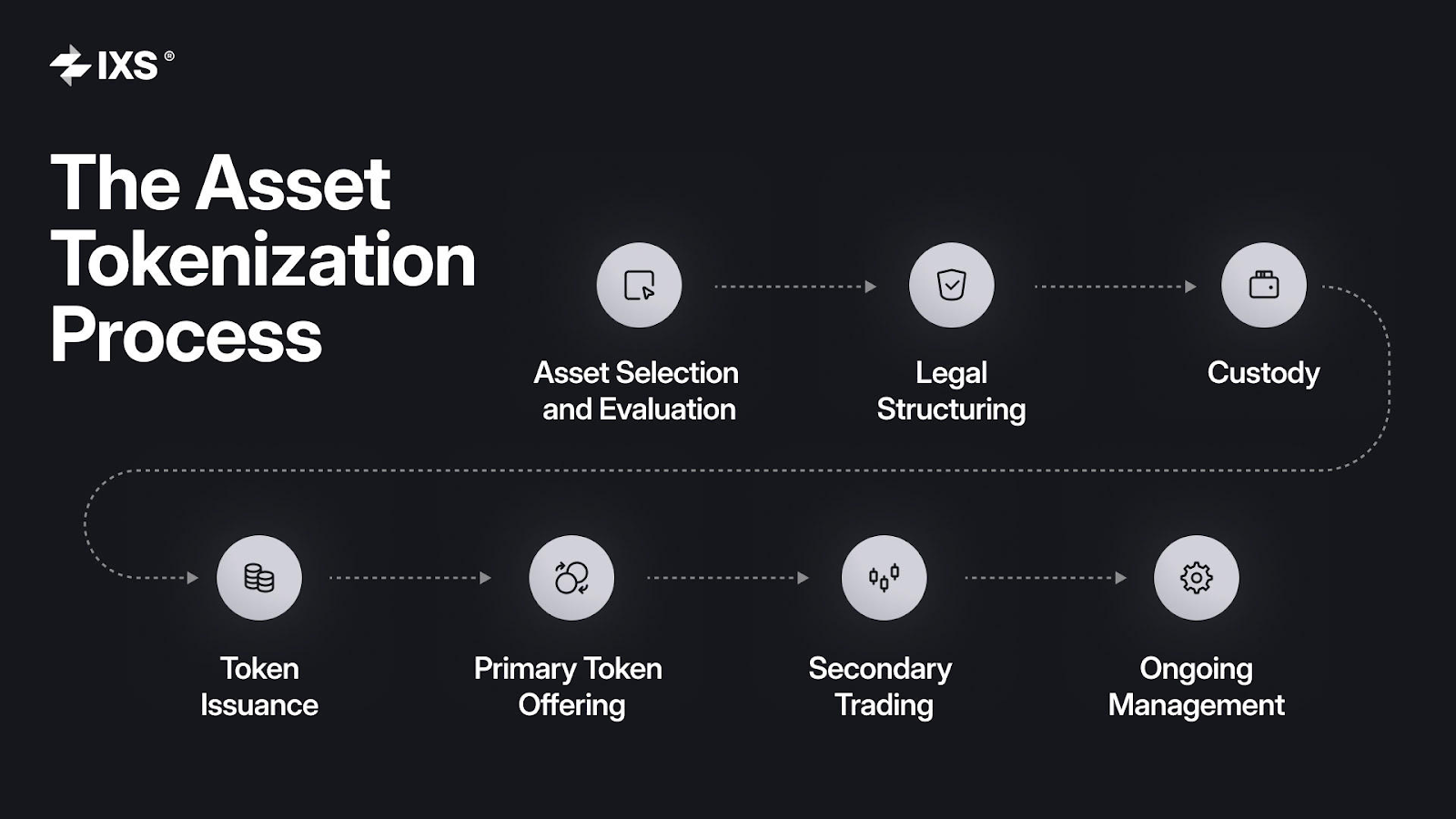
1. Asset Structuring
A physical asset can be tokenized directly. But issuers commonly use “indirect” approaches via a Special Purpose Vehicle (SPV), where tokens represent certain financial and economic rights to the asset rather than the asset itself.
- The SPV Model: In fund tokenization, a common structure is to establish an SPV that functions as a tokenized feeder fund investing into a master fund. The tokens represent interests in the SPV, which in turn holds an interest in the master fund. The master fund itself may or may not be tokenized.
- Tokenizing Shares: The tokens issued represent shares or units in that SPV. This structure helps issuers operate within recognized legal frameworks, ensuring that the token functions as a compliant security.
2. The Ecosystem
You will need to assemble a network of service providers. This is where asset tokenization platforms like IXS come in to provide connectivity.
- The Technology Provider: Provides the smart contract infrastructure to mint tokens and manage lifecycle events.
- The Custodian: Safeguards the digital assets or the underlying keys.
- Legal Counsel: Drafts the offering documents (PPM) to include specific language regarding digital ownership.
3. Issuance and Distribution
Once the structure is ready, the tokens are "minted" on the blockchain. But they aren't just sent anywhere.
- Whitelisting: Smart contracts can enforce compliance rules. For example, a token can be programmed so it can only be held by a wallet associated with a KYC-verified investor.
- Subscription: Investors subscribe using fiat or stablecoins, and the smart contract updates the registry automatically.
4. Secondary Trading
Following the initial offering, RWA tokens may be traded on secondary markets through various channels, such as licensed exchanges, broker-dealers, or decentralized exchanges. This provides liquidity through peer-to-peer deals or automated markets.
5. Ongoing Management
This includes essential services like compliance monitoring, asset valuations, tax handling, and investor actions like dividends or voting. Regular audits and regulatory updates support this phase through maturity.
Real-World Examples Of Tokenized Funds
By 2026, the market has moved past proof-of-concept pilots. We now see large-scale deployment.
- Money Market Funds (MMFs): Global asset managers like BlackRock (BUIDL) and Franklin Templeton (BENJI) have demonstrated that tokenized treasury funds can offer stable, on-chain yield. These products have grown to billions in AUM because they serve a specific utility: a safe place to park on-chain capital.
- High Yield Corporate Bond: Moving beyond risk-free rates, the market is now accessing higher-yield credit. A prime example is the IXS Launch of BlackRock’s High Yield Corporate Bond Vault, which tokenizes exposure to the BlackRock Corporate High Yield Fund. This structure allows eligible investors to access institutional-grade corporate credit on-chain.
- Private Credit: Firms like Apollo Global Management have utilized tokenization to streamline the issuance of private credit funds.
- Asian Innovation: In Singapore, huge strides have been made under Project Guardian, where banks have tokenized variable capital companies (VCCs) to test more efficient asset servicing.
It signals that tokenization is becoming a standard tool for asset management, specifically for products linked to real economic activity.
Benefits and Risks of Tokenized Funds
Moving on-chain offers distinct operational advantages, but it also introduces new considerations.
The Benefits
- Operational Efficiency: Smart contracts can automate corporate actions. When a tokenized investment fund generates yield, distributions can be pushed to hundreds of token holders in a single transaction. This aligns with State Street’s 2025 Digital Asset Survey, where 52% of institutions cited "increased transparency" and operational clarity as a primary driver for adoption.
- Settlement Speed Tokenization creates the potential to move from T+2 settlement cycles to near-instant (T+0) settlement. In a podcast episode, MAS Chief Fintech Officer Kenneth Gay cites initiatives like Project Guardian and Project BLOOM as catalysts for faster cross-border payments. This reflects market demand, with State Street reporting that ~39% of investors prioritize "faster trading" when exploring digital assets.
- Expanded Distribution: Tokenization allows for fractionalization. By lowering minimum ticket sizes, issuers can potentially access a broader base of accredited investors who were previously priced out of private markets.
- Collateral Utility: As we saw in 2025 with the rise of collateralized lending, tokenized fund units can often be used as collateral in DeFi protocols or institutional lending markets, potentially unlocking liquidity for investors.
The Risks and Challenges
- The Liquidity Illusion: Tokenization enables tradability but does not guarantee buyers. An Arxiv publication, "RWA Liquidity Challenges," affirms that liquidity remains a bottleneck, suggesting hybrid market structures as a necessary solution.
- Integration Friction: Bridging blockchain data with legacy systems is complex. The DTCC’s "Digital Asset Securities Control Principles" emphasizes that robust control frameworks are essential to manage this integration safely.
- Regulatory Variance: Regulatory approaches vary by jurisdictions. Some jurisdictions like the U.S. are working to integrate tokenized instruments into existing securities laws, while others like Singapore and Australia are prioritizing supervised pilots. And most frameworks remain in flux. Aligning them is critical to establishing the legal certainty required for assets to flow seamlessly across borders.
Conclusion
Fund tokenization represents a fundamental upgrade to market infrastructure. The technology is live, and the regulatory pathways are clearer than they were even a year ago.
IXS offers the licensed infrastructure and connectivity needed to bridge traditional capital with the on-chain economy. The transition is underway, and the foundation for the next decade of asset management is ready.